Your weapon is a young boy’s “tears.” The Binding of Isaac: Rebirth is a roguelike action game about Isaac, who flees his mother — driven by the voice of God — and descends into the depths beneath his basement. The dungeon layout and the items you find are entirely random every run. Thanks to the chemical reactions created when items “stack” on each other, it keeps drawing in new players more than a decade after its 2014 release — one of the genre’s founding works.
Game Info
| Title | The Binding of Isaac: Rebirth |
|---|---|
| Developer | Nicalis, Inc. / Edmund McMillen (Japanese console versions published by Pikii) |
| Platforms | Nintendo Switch / Steam / PlayStation and more |
| Price | Steam version ¥1,480 (tax incl., checked November 2026) / Switch version ¥2,200 (tax incl.) |
| Genre | Shooter > Twin-Stick > Roguelike |
| Players | 1 player (local co-op via screen sharing supported) |
| Age Rating | CERO C (ages 15 and up) |
| Estimated Playtime | A single adventure runs about 30 minutes to an hour. Including ending branches and item collection, expect anywhere from dozens to hundreds of hours |
| Languages | Japanese supported on the Switch version / Note: the Steam version of "Rebirth" on its own is English only |
Where to buy: Steam (PC) / The Switch version is also available on the Nintendo eShop
Who This Is For
- People who can enjoy “a different run every time” for dozens of hours
- People who love build crafting — thinking through item combinations
- People drawn to a dark, twisted world behind a cute art style
What Kind of Game Is It?
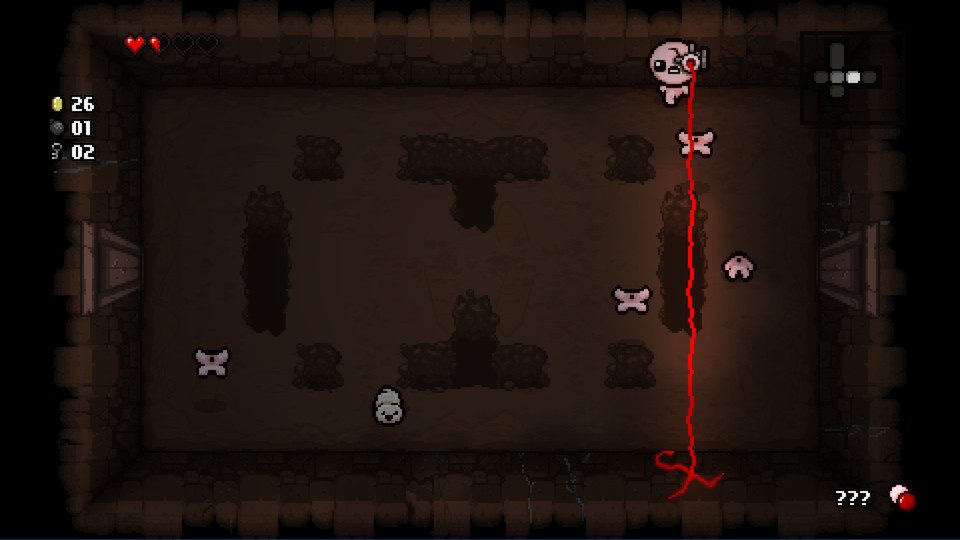
Young Isaac flees his knife-wielding mother into the basement. From there, he pushes through a randomly generated dungeon of individual rooms, firing his tears like bullets. Die, and you start over — but the dungeon structure and the items on the ground are all reshuffled next time.
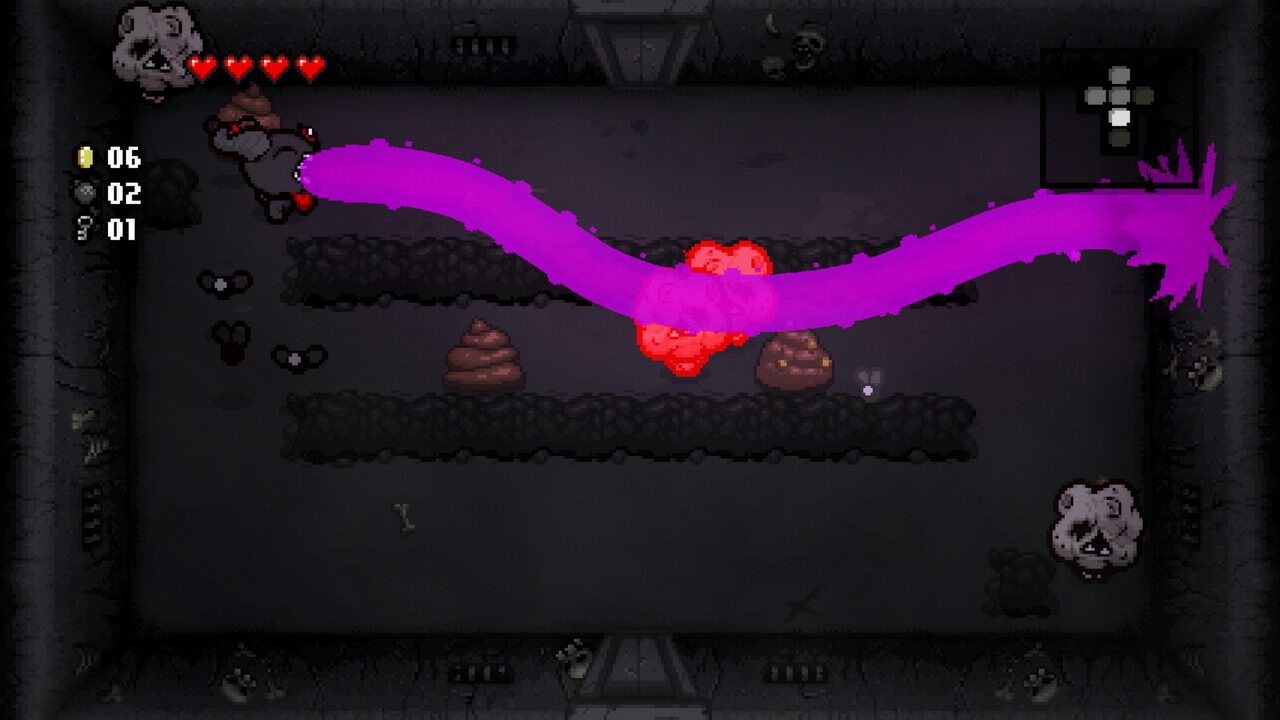
A top-down twin-stick shooter where you defeat enemies by firing tears (official screenshot) © Nicalis, Inc.
The items are the heart of it. Pick one up and Isaac’s appearance and abilities change; the trajectory, fire rate, and power of his tears become something else entirely. There are hundreds of items, and depending on the combination, a run can turn out “broken, in the best way” or “completely hopeless.” That swing is the core of the game’s appeal.
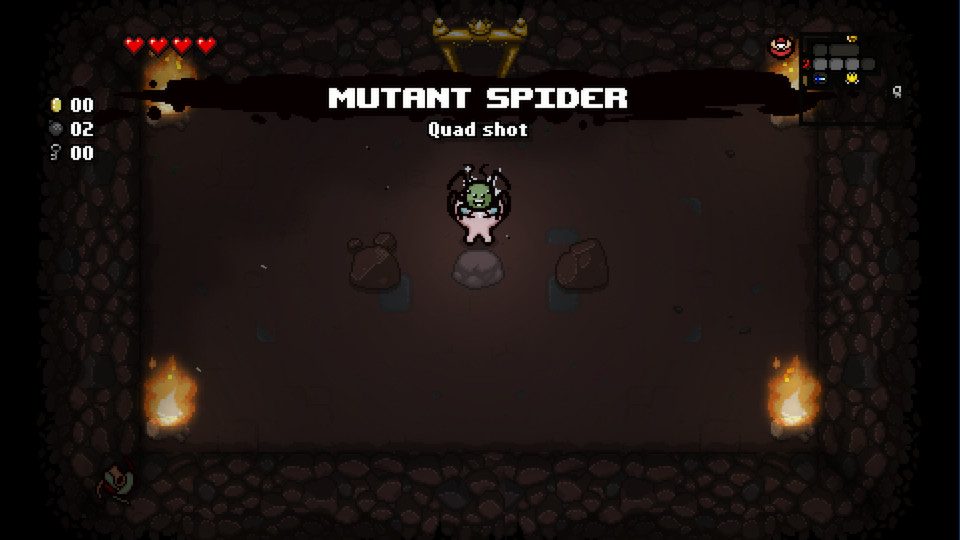
Every item on a pedestal changes how Isaac looks and fights (official screenshot) © Nicalis, Inc.
More than a decade after release, its popularity hasn’t faded: it has been expanded continuously, all the way up to the major expansion Repentance, and it shows remarkable longevity — breaking its own concurrent-player records with every sale.
What Makes It Special (A Creator’s Take)
1. Item effects designed as “multiplication,” not “addition”
The items here don’t simply raise stats — they rewrite the very nature of your tears. Homing tears, piercing tears, splitting tears… stack them, and behavior emerges that not even the developers fully anticipated. This “design of synergies” is the game’s great invention, and you can feel its influence in how roguelikes afterward raced to deepen their item combinations.
2. Run structure engineered to make you say “just one more”
One adventure takes 30 minutes to an hour. Precisely because it’s short, a loss leaves you reaching for another try: “The next run’s items have to be better.” And within a single run, small decisions are packed in tightly — exploring each floor, hunting for secret rooms, juggling health, keys, and bombs — so repetition never becomes a chore. It’s a design that makes you run a marathon at a sprinter’s pace.
3. An absurd world, and a story told in fragments
Grotesque enemies and items, sometimes scatological. The biblical source material is intense, but the heart of the story isn’t delivered in cutscenes — it seeps out of room details, item names, and fragments of endings. By not explaining, the game created soil where players’ interpretations and theories have continued for over a decade. It’s why the venomous presentation and heavy themes never end up as mere shock value.
Points to Note
- The presentation is very much an acquired taste. If blood, grotesque designs, or religious motifs bother you, this isn’t for you (CERO C, ages 15 and up)
- Item effects are not explained in-game. There’s a deliberate unfriendliness that assumes you’ll learn them or look them up as you play
- The Steam version of “Rebirth” on its own does not support Japanese. If you want to play in Japanese, the Switch version is the safe choice
- The game has since been expanded up to Repentance. Before buying, it’s worth checking what’s included and deciding whether to buy the base game alone or a more complete edition
Similar Games / What to Play Next
- For the narrative side of roguelikes, try Hades, also introduced on this site. Reading it against Isaac — as the opposite pole, or the same lineage, of “the story advances each time you die” design — is fascinating
- For action density and item collecting, Enter the Gungeon is another great match
Wrapping Up
The Binding of Isaac: Rebirth is a roguelike classic that proved item combinations alone can make a game endlessly replayable. If you can stomach its venom, ¥1,480 buys you hundreds of hours of “just one more run.”
- This article is based on official information, store pages, and publicly released footage.
- All images in this article are official materials (© Nicalis, Inc.)
- Prices and specifications are as confirmed in November 2026.