It began as a webcomic in 2011, and after a long production it finally launched on Christmas Day, 2020. OMORI is an RPG that travels between a vivid dream world and a faded real-world town, telling the story of a boy confronting the things he has been turning away from. It is known for the gap between its cute art and its heavy themes, and it holds a Metacritic score of 88.
Game Info
| Title | OMORI |
|---|---|
| Developer | OMOCAT, LLC |
| Platforms | Nintendo Switch / Steam (PC / Mac) / PlayStation 4 / Xbox One |
| Price | Steam version ¥1,980 (tax incl., checked November 2026) |
| Genre | RPG > Turn-Based RPG > Horror |
| Players | 1 |
| Estimated Playtime | Around 20–25 hours to clear the main story |
| Languages | English and Japanese supported |
Where to buy: Steam (PC) / The Switch version is also available on the Nintendo eShop
Who This Is For
- People who want to sink deep into a story and its characters, more than into demanding combat
- People drawn to the gap between a cute surface and heavy themes
- People who love RPGs where the everyday and the uncanny touch, in the tradition of the MOTHER / EarthBound series
What Kind of Game Is It?
The protagonist, Sunny, is a boy who has shut himself in his room. When he sleeps, he becomes his other self, Omori, in the dream world of Headspace, adventuring with his friends Aubrey, Kel, and Hero. The dream parts and the real-world parts alternate, and the clues gathered in both worlds gradually converge into a single story.
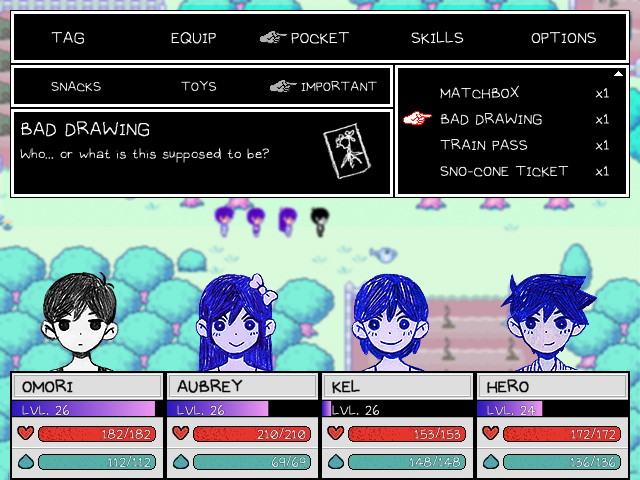
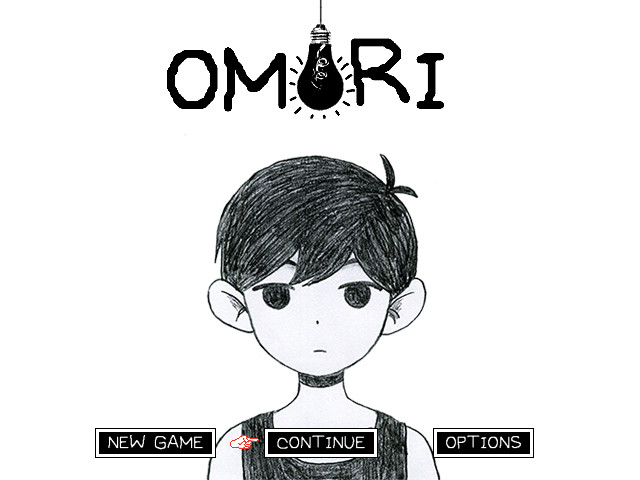
A menu screen lined with hand-drawn-style portraits (official screenshot) © OMOCAT, LLC
Combat is turn-based, and its signature is the emotion system: characters’ emotions (Happy, Sad, Angry, and more) affect one another in a rock-paper-scissors triangle, and stats shift with feeling. Note that, as the store page itself warns, the game contains depictions of heavy themes such as anxiety and loss. This article will not touch the heart of the story.
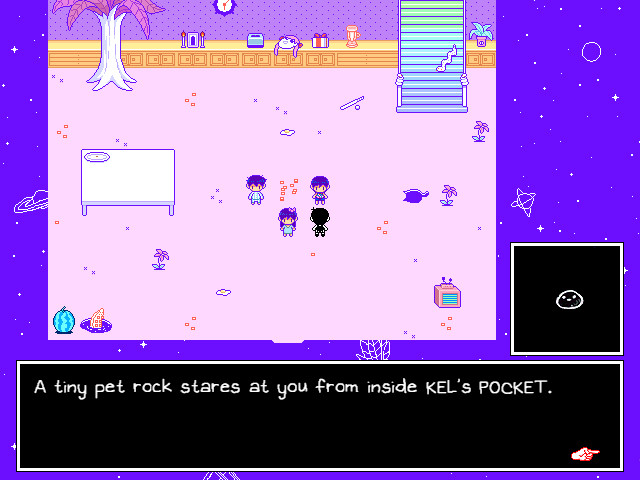
Walking the colorful dream world of Headspace with friends (official screenshot) © OMOCAT, LLC
Its origin is unusual, too: it grew out of creator OMOCAT’s webcomic OMORI’S STORY, passed through crowdfunding, and took roughly a decade to complete. Ports and merchandise followed the release, and it keeps a devoted fandom.
What Makes It Special (A Creator’s Take)
1. Emotion sits at the center of combat — not as a status effect
In most RPGs, emotion belongs to presentation and flavor. Here it is the strategic axis: skills that change an enemy’s emotion, and your own feelings raising or lowering attack and speed. Because the work’s theme — the state of a heart — is itself the tactical reading game, fighting functions as a metaphor for the story.
2. The gap in art materials between dream and reality does the storytelling
The dream world is colorful, hand-drawn-style pixel art; the real town is pale and subdued. Photograph-like backgrounds and sketchy illustrations swap in scene by scene. The choice of medium itself tells you which world you are in — and whose inner landscape you are seeing — so the design rarely needs explanatory text.
3. A decade of production gives it the weight of a personal history
From webcomic to crowdfunding to a long development: that history is part of the work’s gravity. Dream-diary motifs and nods to the RPG Maker horror lineage place it on top of a deep doujin culture, and overseas it has been praised as the arrival point of the “RPG in which the creator’s life seeps through.”
Points to Note
- The themes are genuinely heavy. If depictions of anxiety, depression, or losing someone dear are hard for you, read the warnings on the store page carefully before buying
- Combat difficulty is on the gentle side; players who prize challenge may find the middle stretch a little plain
- The heart of the story is extremely vulnerable to spoilers. Going in with as little prior information as possible is strongly recommended
Similar Games / What to Play Next
- For the other pillar of “cute art × a story of the heart,” head to UNDERTALE — the one with the option not to fight
- EarthBound (MOTHER 2 in Japan), the wellspring of everyday-meets-strange RPGs, is the title most often discussed alongside it
Wrapping Up
OMORI holds the joy of its dream world and the weight of its real-world story in a single RPG, head-on, without flinching from either. It is not for everyone — but for the people it reaches, it stays with them for a long time.
- This article is based on official information, store pages, and publicly released footage.
- All images in this article are official materials (© OMOCAT, LLC)
- Prices and specifications are as confirmed in November 2026.